


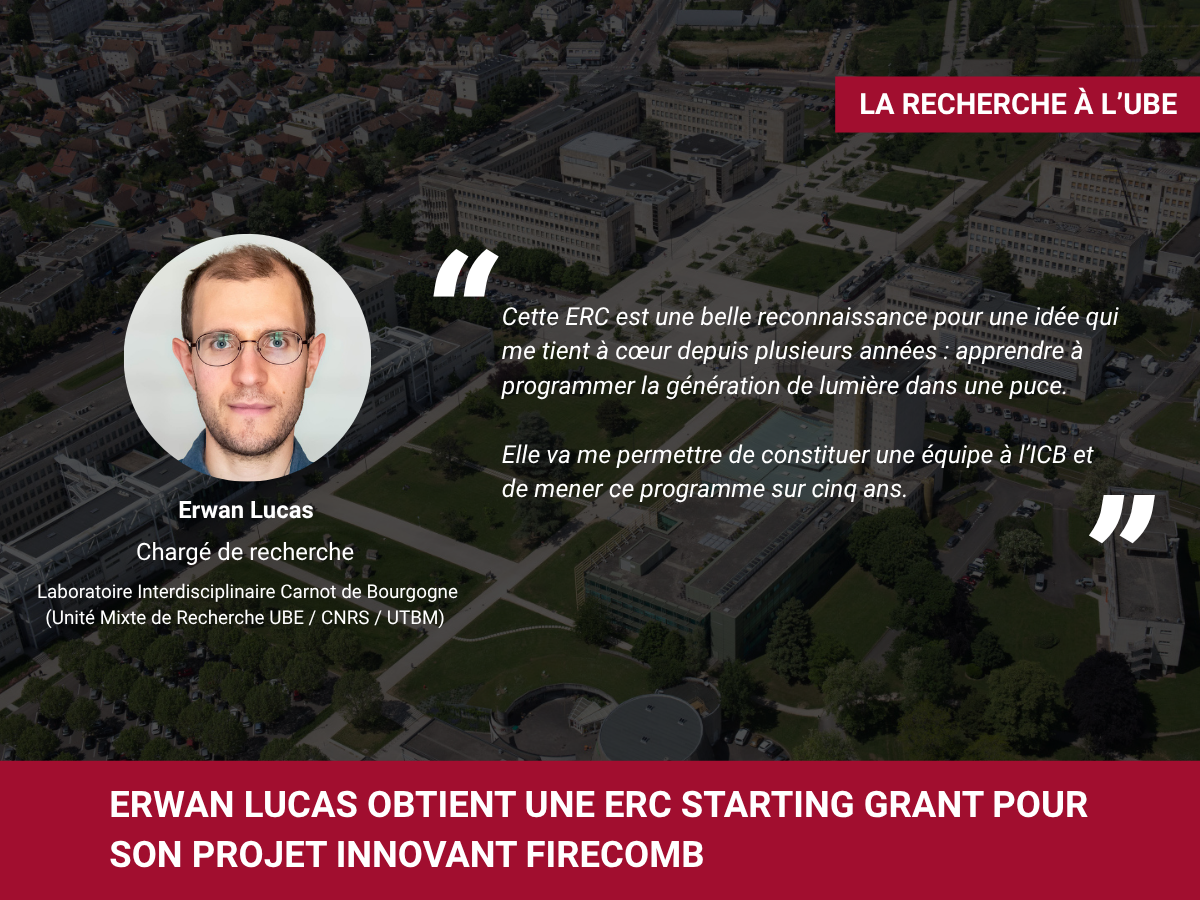
Erwan Lucas, Research Scientist at the Laboratoire Interdisciplinaire Carnot de Bourgogne (Joint Research Unit of Université Bourgogne Europe, CNRS and UTBM), has been awarded a 2026 European Research Council (ERC) Starting Grant for his FIRECOMB project.
This prestigious and highly competitive European distinction recognises the excellence and ambition of the research conducted within Université Bourgogne Europe’s laboratories.
This achievement is part of a positive momentum for UBE, with several European research projects receiving funding, particularly since the establishment of its STRADA support unit*, which works closely with the CNRS’s national and regional research valorisation services.
Erwan Lucas, a researcher at the Laboratoire Interdisciplinaire Carnot de Bourgogne, has been awarded a 2026 ERC Starting Grant for his FIRECOMB project, which focuses on programming light on a chip. This distinction further highlights the dynamism of research at Université Bourgogne Europe, also reflected in the recognition received by several faculty members from the Institut Universitaire de France (IUF, four this year) and the inclusion of members of the UBE community in Stanford University’s ranking of the world’s most influential scientists (98 this year).
FIRECOMB: Programming light to develop tailor-made optical sources
Optical frequency combs are essentially rulers made of light. They consist of thousands of light frequencies, comparable to the teeth of a comb, arranged at perfectly regular intervals. This exceptional precision has revolutionised fields such as timekeeping, material analysis and telecommunications. Today, thanks to so-called microcombs, these tools can be miniaturised and integrated onto a chip using tiny optical resonators.
But how can light be generated to meet the precise requirements of each application? This is the central challenge addressed by the FIRECOMB project. Rather than starting with an existing chip and adapting to the light it produces, Erwan Lucas is proposing an innovative approach: designing the chip based on the desired light output.
To achieve this, the project will combine modelling and artificial intelligence to determine the characteristics of the device capable of generating the desired frequency comb. Using new microresonators, in which each optical “note” can be individually tuned, FIRECOMB aims to make light programmable and develop tailor-made optical sources. In the longer term, these innovations could help improve communication networks, radar systems, ultra-precise clocks and the sensors of tomorrow.
“This ERC Grant is a wonderful recognition of an idea that I have been passionate about for several years: learning how to programme light generation on a chip. It will enable me to build a research team at ICB and carry out this programme over five years. I would like to thank UBE’s STRADA unit, whose support was invaluable in developing and refining the presentation of the project before the European evaluation panel, as well as the CNRS and my laboratory colleagues and the wider research community for their support.”
The ERC Starting Grant: European funding for scientific excellence
Established by the European Union, the European Research Council (ERC) supports the most ambitious frontier research projects across all scientific disciplines. Its funding is based on one fundamental principle: scientific excellence, assessed by international experts.
The highly competitive ERC Starting Grant is awarded to researchers who obtained their PhD between two and seven years prior to the call, enabling them to develop ambitious, pioneering research projects. The grant can provide up to €1.5 million over a maximum period of five years, with additional funding available under certain conditions.
Since 2024, engineers from the STRADA support unit (part of the ASDESR project led by UBE and funded through the France Relance recovery programme) have been assisting researchers and faculty members seeking to secure highly competitive European research funding. They provide personalised, dedicated support throughout the preparation and submission of European research proposals, working in close coordination with the CNRS’s regional and national support teams for the benefit of the Université Bourgogne Europe research community.