


The RITM-BFC conference showcased educational innovation in Bourgogne-Franche-Comté
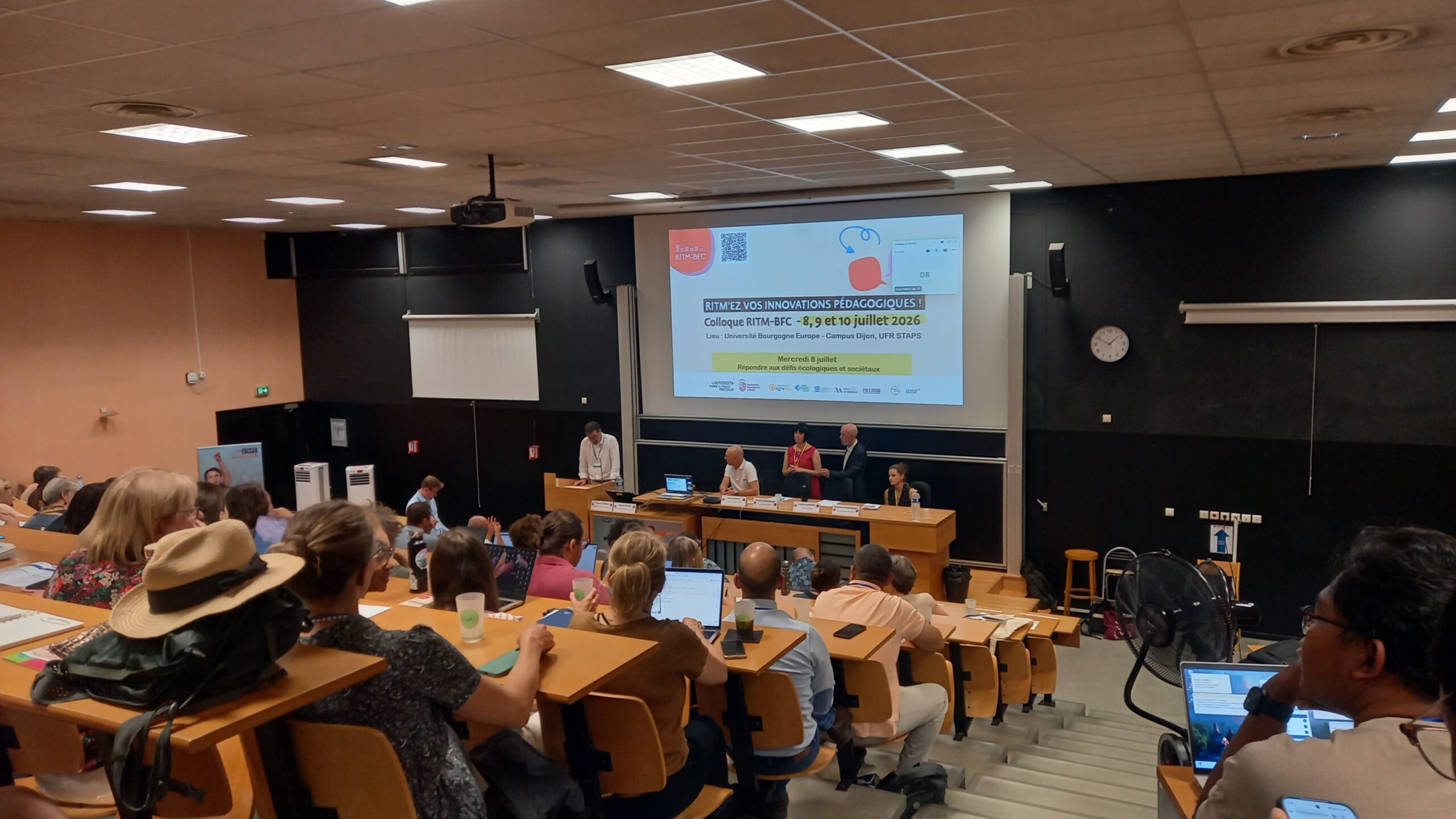
The 4th edition of ‘RITM’EZ VOS INNOVATIONS PEDAGOGIQUES !’ brought together 150 participants from 8 to 10 July 2026 at UniversitéBourgogne Europe. Over the course of three days, more than 70 sessions and project presentations highlighted innovative educational initiatives being implemented in schools across Bourgogne-Franche-Comté, enabled the sharing of best practice and provided an opportunity to look to the future. A look back at this key event centred on an acronym (RITM-BFC): ‘Succeed – Innovate – Transform – Mobilise’ in Bourgogne-Franche-Comté.
The RITM-BFC project, which aims to promote and improve student success and to develop lifelong learning, organised its fourth conference in Dijon – jointly opened by Vincent Thomas, President of the University of Burgundy Europe, and Hugues Daussy, President of Université Marie et Louis Pasteur. The overarching theme? ‘Supporting and accelerating pedagogical transformations in Higher Education and Research in light of societal challenges’.
Success
During the round-table discussion on ‘(In)equalities in access to higher education and research’, the topic of ‘student success through the lens of Equity, Diversity, Inclusion and Accessibility’ was addressed. Workshops on peer tutoring and the evaluation of student success schemes (backed by research findings in educational sciences) were presented to participants.
Innovation
Especially for this conference, a comic strip on the recognition of skills was created by Thibault Roy and displayed throughout the three days. Creative session formats, such as ‘speed dating’ sessions for educational projects, were well received by participants, enabling them to gain an overview of the projects presented.
Transforming
Denis Bédard, associate professor at the University of Sherbrooke, introduced the discussions in the session ‘How can innovations transform teaching practices? ’
The session ‘RITM-BFC Teaching Residencies: Experimenting to Transform’ once again demonstrated the value of this unique initiative, inspired by artist residencies. The round-table discussion ‘Ecological Transition: Preparing the Actors of Today and Tomorrow’ showed how a continuum of training on these issues prepares learners to become active participants in the TEDS (*). Finally, the workshop ‘Higher Education in 2050: a participatory foresight workshop’ enabled participants to collectively envisage long-term transformations using various scenarios.
Especially for this conference, a comic strip on the recognition of skills was created by Thibault Roy and displayed throughout the three days. Creative session formats, such as ‘speed dating’ sessions for educational projects, were well received by participants, enabling them to gain an overview of the projects presented.
Transforming
Denis Bédard, associate professor at the University of Sherbrooke, introduced the discussions in the session ‘How can innovations transform teaching practices? ’
The session ‘RITM-BFC Teaching Residencies: Experimenting to Transform’ once again demonstrated the value of this unique initiative, inspired by artist residencies. The round-table discussion ‘Ecological Transition: Preparing the Actors of Today and Tomorrow’ showed how a continuum of training on these issues prepares learners to become active participants in the TEDS (*). Finally, the workshop ‘Higher Education in 2050: a participatory foresight workshop’ enabled participants to collectively envisage long-term transformations using various scenarios.
Bringing people together
Teachers, research lecturers, educational engineers, staff, partners, socio-economic stakeholders, students and PhD candidates from 33 institutions attended, demonstrating the influence of RITM-BFC and the projects it supports. Among these were research projects – some of which were presented during the workshop ‘Research projects to inform student success’.
And because educational journeys do not end with a degree, the round-table discussion ‘Training for action: higher education and research in the face of evolving lifelong learning pathways’ highlighted the strong links with the socio-economic world. The topic was introduced by Michel Lugnier, Inspector-General for Education, Sport and Research, and placed in its historical context.
What next?
Funded by the ANR, RITM-BFC will continue until 2028. In 2025, the NCU received a ‘remarkable’ rating from an international panel and now brings together over a thousand stakeholders across 256 projects throughout the region.
A very positive momentum has enabled the development of collective expertise in educational innovation and transformation across the region – the transformative impact of RITM-BFC is now widely recognised – fuelled by networking with the NCUs (New University Curricula) and stakeholders in university education across the French-speaking world.
The workshop and discussion session entitled ‘Sustaining Transformative Initiatives’ provided an opportunity for collective reflection on the factors that ensure sustainability, attended in particular by Bertrand Monthubert (Atypie-Friendly), Alexandra Oberlé (écri+) and the former coordinator of RITM-BFC, Sébastien Chevalier (Ministry of Culture).
What are the challenges facing the long-term sustainability of RITM-BFC?
The establishment and expansion of projects in Bourgogne-Franche-Comté, the continuation of a process of far-reaching educational transformation, and the development of skills better aligned with the expectations of the socio-economic environment.
Better still… a dynamic capable of addressing major societal challenges within higher education and research.
(*) Ecological Transition for Sustainable Development
Find out more:
About RITM-BFC: https://www.umlp.fr/ritm-bfc
About the conference: https://ritmbfc-2026.sciencesconf.org
RITM-BFC contacts:
Co-coordinators: frederic.muyard@univ-fcomte.fr sandrine.rousseaux@u-bourgogne.fr
Operations Director: pascaline.personnier@univ-fcomte.fr