


A major methodological breakthrough for revealing invisible pigments in biominerals
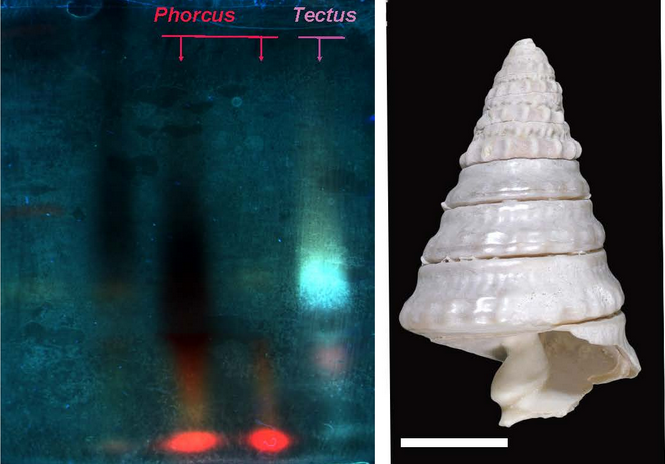
Researchers at the Université Bourgogne Europe, in partnership with teams from the CNRS, notably at the Institute of Ecology and Environment, have developed an innovative method for detecting biological pigments in biominerals that were previously undetectable.
Biominerals—such as shells, corals, and certain invertebrate skeletons—contain complex organic molecules that remain difficult to identify analytically. The new approach combines electrophoresis and luminescence spectral imaging, offering increased sensitivity without the use of dyes or chemical treatments that could alter the samples. This strategy makes it possible to directly observe, within the analysis gels, the spectral signatures of biochromes and their interactions with mineral matrices.
Applied to modern and fossil shells dating from the Eocene epoch, the method has made it possible to detect trace amounts of porphyrins, demonstrating its potential for studying ancient materials and precisely characterising fossilisation processes.
This research, published in the journal Methods in Ecology and Evolution, opens up significant prospects in molecular palaeontology, biogeosciences and analytical chemistry. It illustrates the commitment of the University of Burgundy Europe to developing cutting-edge interdisciplinary approaches to understanding the biological and environmental archives of the past.
CNRS laboratories involved
- Biogéosciences (BGS – CNRS / Université Bourgogne Europe)
- Centre de recherche en Paléontologie (CR2P – CNRS / MNHN / Sorbonne Université)
- Institut de Chimie Moléculaire de l’Université de Bourgogne (ICMUB – CNRS / Université Bourgogne Europe)
- Institut Photonique d’Analyse Non-destructive Européen des Matériaux Anciens (IPANEMA – CNRS / Ministère de la Culture / MNHN / Université Versailles Saint Quentin)
- Laboratoire de Chimie de la Matière Condensée de Paris (LCMCP – CNRS / Sorbonne Université)